

As the subject of generative artificial intelligence (gen AI) is discussed and debated everywhere from boardrooms to breakfast tables, consultancies are eagerly using gen AI to improve their own processes and output—and then use the insights they’ve developed from their own journey to guide clients on the complicated trust, ethical, and performance issues the technology raises.
Generative AI is a machine learning system that can generate text, images, code, and other types of content, often in response to a prompt entered by a user in everyday language. IBM Corp. believes a large part of its consultants’ work will be impacted by gen AI, from creating better business cases to generating code faster.
“We see a significant amount of value creation generated from gen AI,” says Jesus Mantas, global managing partner of Business Transformation Services for IBM Consulting, IBM Corp.’s consulting subsidiary headquartered in Armonk, N.Y. “We see productivity gains from gen AI. We see acceleration of work. We see new ways of working. We see that for our clients, and we see that for ourselves.”
Professional services and consulting firms that have staked early claims to gen AI leadership are already seeing promising results. At KPMG International
H I G H L I G H T S
 Using generative artificial intelligence (gen AI) as a general productivity tool fits nicely into the changing world of consulting, where the traditional approach of simply executing a list of client requirements has been replaced by cocreation.
As hungry as professionals are for gen AI, consultancies are finding that the technology is not yet suitable for every task.
While there is a huge potential reward, that also comes with risk that must be analyzed, understood, and dealt with.
Ltd., headquartered in Amstelveen, Netherlands, 60% of the employees who have used the company’s artificial intelligence-powered personal assistant report it has allowed them to spend more time on valuable work. Nearly as many KPMG employees, 58%, report that gen AI has allowed them to spend more time on creativity.
“Our internal surveys show gen AI has a lot of positive benefit in just the employee experience,” says Steve Chase, vice chair of artificial intelligence (AI) and digital innovation at KPMG U.S. “People are clamoring for these tools.”

“Our internal surveys show gen AI has a lot of positive benefit in just the employee experience. People are clamoring for these tools,” says Steve Chase, vice chair of artificial intelligence (AI) and digital
Some consultancies have documented a bottom-line benefit from gen AI. Omni Business Intelligence Solutions, a boutique New York technology consultancy, used ChatGPT to generate personalized business proposals, produce industry-specific marketing materials, and create a ChatGPT training guide for data analysts the firm contracted with. This freed up enough time for the company founder to book $128,000 in new deals from December to March, an 80% increase from the same period a year before.1
Even as they announce such success stories, consultancies are grappling with the same complex and nuanced issues with gen AI that they are advising their clients about. As consultancies position their employees to use the technology, the firms are looking to them to guide their own use of gen AI in an effective, secure, and ethical manner.
The consultancies want to disperse the technology widely and help employees develop skills that allow them to discover new use cases for gen AI that challenge their current ways of working and thinking. Consultancies want to use gen AI to transform virtually every aspect of their operations and create a first-mover advantage. However, they don’t want to move so quickly that they assume benefits from gen AI that have not been proven or take on excessive risk, such as unwittingly exposing clients’ data.
Given how much gen AI has captivated both businesses and the general public, it’s easy to forget that the popular ChatGPT chatbot was launched only in November 2022. “Everything in the gen AI space is so nascent and so fluid, it is the time for consulting companies and professional services to really shine and lead the way forward,” says Beena Ammanath, global head of the Deloitte AI Institute and the technology trust ethics leader for United Kingdom-based Deloitte Touche Tohmatsu Ltd.’s consultancy. “The need for strategy is more important than ever before because you must consider not just value creation but the side effects that can come with gen AI, including security and ethical concerns. Earlier digital technologies didn’t have the same pace of change or wide range of impact as gen AI, whether on the climate or the workforce, so you can’t approach gen AI in the same way as other technologies, even earlier incarnations of artificial intelligence.”
This paper examines the role that professional services and consulting firms can play in developing a framework to enhance the performance, security, trust, and ethics of applications in the emerging gen AI landscape. The paper probes how large and boutique technology consultancies are exploring the use of gen AI in their own operations, and how they intend to expand the learnings and practices from these efforts to their work for their clients. The pathway they are creating for gen AI will likely affect how all industries adopt and use the technology.
Integrating AI into “Everything”
KPMG’s declaration for its AI Transformation program speaks to the all-encompassing impact that the consultancy expects from gen AI: “Our mission is to integrate AI into everything we do.” The program tracks progress and ROI across five pillars: “The way we market and sell our services; the services we sell; the way we deliver our services; how we respond to business model disruption; how we run the business.”
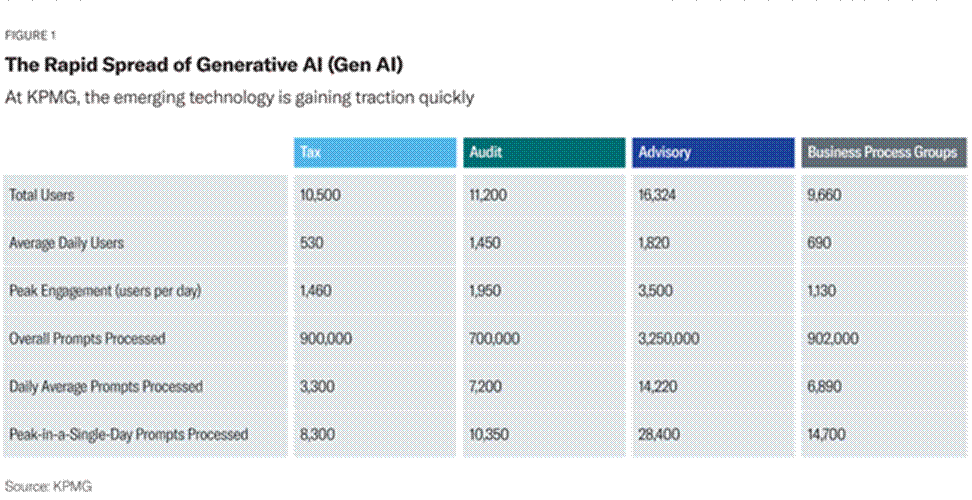
That pledge is already being fulfilled. Since last year, KPMG has rolled out gen AI capabilities to more than 16,000 of its advisors and more than 45,000 members of its total workforce across four units. On average, nearly 10% of that workforce use gen AI every day for such tasks as business communications, decision support, coding assistance, and content creation. FIGURE 1
The consultancy is using gen AI to provide operational efficiencies in back- and middle-office services like IT services, human resources, finance, and risk. For example, the finance function has used gen AI to streamline creation of recurring materials for financial close, operations, and business reviews. HR is integrating a new AI tool—nicknamed “Kai”—into the recruiting process, which leverages digital discussions to help candidates find the right job and better understand KPMG’s culture, benefits, values, and more. Once candidates are identified by the firm’s recruiting team, Kai also digitizes and streamlines interview scheduling and rescheduling. The technology is also speeding software development at the consultancy.
Harvard Business Review Analytic Services
At this point, greater efficiency is the prime calling card of gen AI. KPMG found that using gen AI trimmed 30 minutes off the time it took to do coding assistance. A competitive intelligence study can be produced in 90 fewer minutes because of the technology. These small increments of time add up to a huge cumulative advantage for fast-growing organizations that have trouble finding enough skilled workers.
Using gen AI as a general productivity tool fits nicely into the changing world of consulting, where the traditional approach of simply executing a list of client requirements has been replaced by cocreation. Consultancies now collaborate with their clients, their clients’ customers, and other stakeholders in a team-like approach. The gen AI “assistants” operate in a manner similar to chatbots. However, the assistants don’t use pre-scripted language like a bot does, so their conversations are more engaging, personalized, and contextualized. The assistants’ greater ability to grasp the user’s intent, nuances, and context allows them to take over tedious tasks or summarize information at an astounding speed. With this AI augmentation, consultants can focus their human creativity in a way that makes the greatest impact.
IBM Consulting has developed an AI services platform that includes a library of hundreds of AI assistants that have been trained with data for specific tasks, like creating the requirements for a mobile app. An IBM consultant who is helping a health care provider might ask the gen AI assistant to create a persona map for a tech-savvy Millennial in the U.S. who is looking to book an appointment with his or her doctor online. The assistant would provide scenarios and acceptable criteria that affect the app’s design.
In the past, this exercise might have taken a consultant half a day and multiple interactions. The gen AI assistant spins a baseline persona in less than 60 seconds. “The persona map doesn’t need to be perfect,” IBM’s Mantas says. “It just needs

“The persona map doesn’t need to be perfect. It just needs to provide a base that the consultant can then use with the client and edit, rather than start from scratch,” says Jesus Mantas, global managing partner of Business Transformation Services for IBM Consulting.

to provide a base that the consultant can then use with the client and edit, rather than start from scratch.”
As hungry as professionals are for gen AI, consultancies are finding that the technology is not yet suitable for every task. Intentional Futures LLC, a small Seattle-based consultancy, found that gen AI tools allowed consultants to accomplish weeks’ worth of research in only a few days. In some cases, however, consultants also reported numerous inaccuracies, known as “hallucinations,” in the material that gen AI prepared. Reviewing and revising the material for accuracy, timeliness, and industry-specific context could sometimes take the consultancies more time than preparing the material on their own.2
Consultancies are trying to zero in on the best ways to apply the technology in its current form. Consider an experiment conducted at Boston Consulting Group Inc., a technology consultancy in Boston. OpenAI’s GLT-5, a large language model (LLM)—a gen AI model that can understand and generate language—was used for creative ideation. BCG consultants who used GLT-5 performed 40% better than a control group that didn’t use the technology. However, when BCG professionals applied GLT-5 to business-problem solving, specifically “to identify the root cause of a company’s challenges based on performance data and interviews with executives,” the results were strikingly different. They performed 23% worse on this task than the control group did.
The reason might be rooted in gen AI’s ability to produce open-ended, novel ideas while lacking the ability to judge the “right answer” in the business question. In any case, this exercise is a stark reminder of how embryonic the gen AI space is, and how much needs to be discovered about it, including the downside of asking gen AI to do tasks that are currently beyond its capabilities.
“Right now, businesses are worried about being left behind when it comes to gen AI,” says Shea Brown, founder and chief executive officer of BABL AI Inc., an Iowa City, Iowa, consultancy that performs audits on AI systems. “But we need to ask tough questions about the risks that gen AI brings and whether there really is ROI in allocating resources to these activities.”
Readying the Workforce
As consultancies look to capture value from gen AI, many feel the pathway begins with developing a gen-AI-capable workforce. Preparing a workforce for a technology that can reshape how work is done is a complex process that must address such delicate issues as worker fears about the technology replacing them.
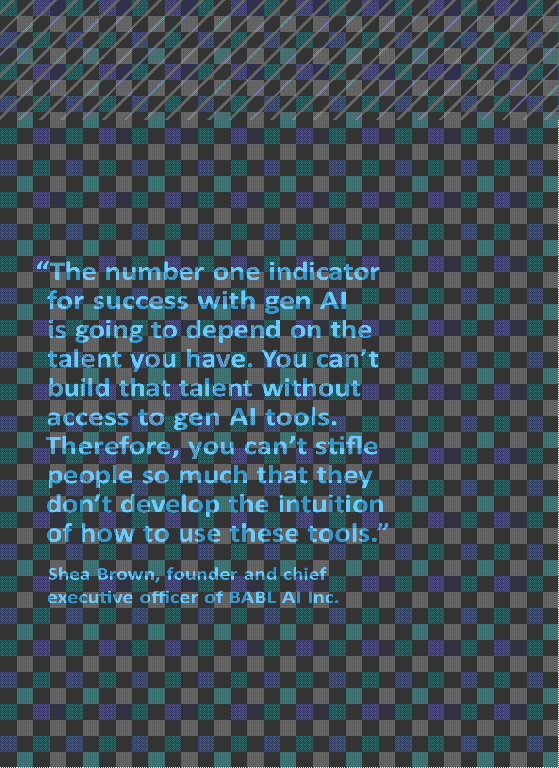
“The number one indicator for success with gen AI is going to depend on the talent you have,” Brown says. “You can’t build that talent without access to gen AI tools. Therefore, you can’t stifle people so much that they don’t develop the intuition of how to use these tools. However, if you say, ‘We have to use gen AI because everyone else is using it’ and just put the technology in the hands of people without giving them the proper training and guidance, you will end up with a bunch of dinosaurs who don’t know how to use the tools.”
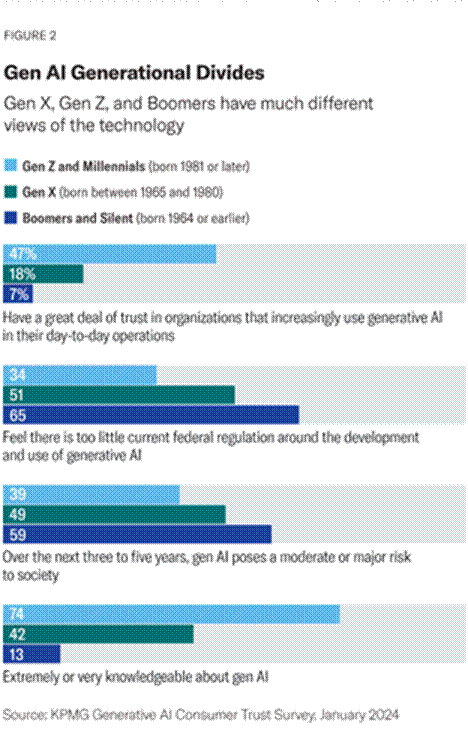
The dinosaur comment is apt, given that generational divides are already apparent in the use of gen AI technology. A January 2024 survey of more than 1,000 adults in the United States by KPMG found that 74% of Gen Z/Millennials are extremely or very knowledgeable about gen AI versus just 42% of Gen X and 13% of Boomers/Silent generation members. Younger generations also tend to have more trust in gen AI. FIGURE 2
To fortify its own workforce, KPMG has developed gen AI “persona-based learning journeys,” which take into consideration the generational differences in how people consume and retain knowledge. Learning champions, whom the consultancy dubs “digital navigators,” are being appointed to guide and support individuals in their learning journeys in different parts of the business. As a result of these efforts, more than 74,000 AI courses were completed by KPMG’s U.S. workforce by the end of 2023.
“Our recommended approach is to start by augmenting your workforce broadly with gen AI capabilities,” KPMG’s Chase says. “Get the technology in the hands of your knowledge workers, spark the innovation curve, and put more of your money into training your people than in training your models.”
This approach has not only helped KPMG identify the most compelling use cases for the technology in its own operations but also provided consultants with the expertise they need to have knowledgeable, far-ranging discussions with clients
 “The consultancies that have AI augmentation are going to win more work,” says Bret Greenstein, a partner for cloud and digital analytics
insights at PwC US.
about gen AI. “We want to empower all our 45,000 consultants to have those conversations because there is so much noise out there about gen AI and what you should be concerned about,” Chase explains.
Like most organizations, PricewaterhouseCoopers International Ltd.’s consultancy, based in London, faces concerns from workers that gen AI will take away their jobs. Bret Greenstein, a partner for cloud and digital analytics insights at PwC US, says the consultancy takes pains to explain how the technology will augment the professionals’ abilities and allow the growing business to capture new opportunities. “We’re coming out of a period where we couldn’t find the people and resources we need to keep up with our level of growth,” he says. “The consultancies that have AI augmentation are going to win more work.”
In educating its own workforce about gen AI, PwC stresses the tedious work the technology removes, allowing the consultants to devote themselves to their true valueadded human thinking. At the same time, PwC works hard to demystify the technology. As part of PwC’s three-year, $1 billion investment in gen AI, 75,000 PwC employees have taken courses on topics such as the ethics of AI, responsible use of AI, and how to prompt AI tools for the best results.
“There’s emotional issues all over the place with gen AI,”
Greenstein says. “I was at a client and someone pitched gen AI using terminology that made everyone more anxious after the meeting than they were before the meeting, like ‘neural networks’ and ‘vectorization.’ The terminology is new. And yet, it’s technology that’s adjacent to skills they already have.”
The intensive educational approach has paid off. As soon as PwC employees developed gen AI skills, they were able to more clearly see where the technology was effective and where its use could be expanded. “They can actually envision use cases that are more transformative,” Greenstein says. “Giving people the ability to write an email faster does not really transform work. But changing a process by putting AI in the front of it does.”
Confronting Ethical Issues
According to the 2023 KPMG CEO Outlook, a survey of 1,300 CEOs at large companies, ethical challenges are the top obstacle to successfully implementing gen AI, followed by cost and talent. The potential ethical issues are both numerous and complex. Gen AI models are trained on massive amounts of data, which can infringe on copyrights and intellectual property rights of other companies. The underlying data can contain sensitive information that can be unwittingly exposed. Gen AI can amplify biases in hiring and other situations.
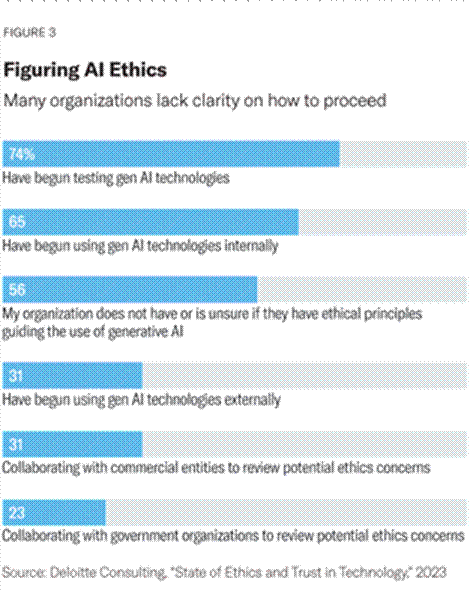
A 2023 Deloitte survey of 1,700 business and technical professionals indicated the extent to which organizations are struggling with even developing an approach to the ethical concerns this emerging technology raises. While most companies have begun using or testing the technology, more than half of survey respondents said their organizations (56%) did not have ethical principles guiding the use of gen AI, or they were unsure if the principles existed. FIGURE 3
In this chaotic landscape, consultancies see themselves as primed to be a guiding force in helping organizations develop strong ethical approaches to gen AI. “Consultancies have a lot of advantages in having a cross-industry view,” says
Deloitte’s Ammanath. “We can see the best practices that are developing in the heavily regulated industries and determine which of their approaches we can apply to the industries that are not so regulated. This is a unique time that allows us to help shape the use of the technology not just in terms of value creation but in the way it impacts human rights, inequalities, and broader access to technology.”
Gen AI governance frameworks can be modeled on responsible and ethical AI principles that have been laid out by organizations such as Google and IBM, as well as risk management frameworks produced by standards organizations. From this starting point, a gen AI governance framework must be adaptable, supporting both flexibility and scalability, says Christine Livingston, global leader of artificial intelligence services at Protiviti Inc., a global consulting firm based in Menlo Park, Calif.
“Not every use case is created the same,” she says. “A bank that is using gen AI to make credit and lending decisions will need a higher level of explainability and transparency in its models, because the bank knows there are going to be regulatory requirements. If an organization is using a gen AI application to answer internal questions, like what is the process for getting a new laptop, it doesn’t need the same level of explainability.”
Protiviti has found that gen AI policies are most effective when they are specific to four characteristics of gen AI applications: the value or function the application delivers, how it is trained, the data on which it is trained, and the architecture on which it runs.
While organizations can use existing AI ethical frameworks as a starting point, each company must put its unique stamp on its own framework, according to Livingston. “In the ethical and responsible AI space, they need to define their own ethics around AI,” she says. “There are frameworks for responsible AI, which focus on things like transparency, fairness, and equity, but you need to understand what your company’s organizational boundaries are in order to apply those frameworks. No one can define your company ethos or your brand values for you.” Meanwhile, she adds, as the gen AI space evolves, regulations will likely evolve and change.
Like their clients, consultancies are trying to determine the best approach for such issues as data privacy. At this moment, they are largely focusing on internal applications that don’t expose sensitive data, keeping the applications securely within their organizations’ walls.
“We don’t want to put client data into this equation yet, so we don’t upload a client document and start querying against it, which is the low-hanging fruit of gen AI,” BABL AI’s Brown says. “You don’t want client data getting out through a gen AI vendor’s database. When you allow AI to make more autonomous decisions—and let it drive action without human oversight—the risks are greater, and not well understood.”

“The models are trained to be very confident, so when the model doesn’t have available information, it will construct something reasonable sounding,” says BABL AI’s Brown.

Consultancies are focused on determining the best ways to handle the many issues that accompany gen AI. These include how to protect their models from attack, how to provide secure environments for the gen AI LLM that excels in natural language processing tasks, and how to protect against model hallucinations, which is the issue of gen AI providing factually incorrect information in a confident veneer.
“The models are trained to be very confident, so when the model doesn’t have available information, it will construct something reasonable sounding,” Brown explains. “Hallucinations are a real thing, but I don’t like that word because it anthropomorphizes the technology.”
His mention of the term “anthropomorphizes” highlights another fundamental issue with gen AI that consultancies are dealing with: Because gen AI produces and understands language so fluently, employees can be lulled into thinking the technology has the same skills as human beings. However, models lack human values, common sense, and actual understanding.
Consultancies find they must constantly remind employees that the output from gen AI systems should be regarded skeptically and vetted against their personal judgment and professional experience. The complex ethics of gen AI must also be brought up to them often, especially in the flow of using the technology.
The gen AI technology can help in this effort. For example, a well-intended programmer, wanting to create a personalized experience for each user, might ask the gen AI assistant to create code that determines the gender of a person based on their name.
“Some people might think that is a good idea, but it could create problems of bias and could lead to significant business issues,” says Mantas. The AI assistant the consultants use contains guardrails so that it would automatically flag the potential for bias in this request, and instead offer alternatives, such as requesting users to provide their preferred pronouns. “Based on those guardrails, the assistant could stop certain tasks that go against stated ethical principles of a company,
 “The companies that use this technology are growing faster than those that don’t. Up until this year, the only way to grow your business was to add more people. That’s no longer true,” PwC’s Greenstein says.
and coach the consultant on why they shouldn’t do it,” he says. “This is the most scalable approach to taking principles of ethics in AI and systematically applying them at the time of use.”
Keys to Derive Value from Gen AI
As consultancies begin to roll out gen AI to their workforce, they have begun to identify some of the key aspects of using the technology most effectively.
Choose the AI insertion point carefully. In order to create value and transform processes, a top consideration is where in the process the gen AI is inserted. PwC’s Greenstein worked with a client who was pummeled with so much information from its customers that the client’s employees couldn’t keep up with the onslaught.
PwC helped design a gen AI solution that analyzed the communications before a human even looked at them. “AI reads everything before a human does,” Greenstein says. “If the information is incomplete, the AI sends it back with a request to include what is missing. If the information is complete, the gen AI summarizes the communications and puts [them] into buckets so the right people are given just the parts that affect them, with a list of recommended steps.”
Provide a great user experience. Given that the value of gen AI often depends on the technology being widely dispersed throughout the organization, the user experience is paramount. “If you look at a lot of AI projects, 80% of the budget goes to the AI, and very little goes to change management, and none goes to the user experience,” Mantas says. Companies should have user experience designers develop interfaces that make it easy for employees to ask questions and engage in conversations with the underlying software, but this important task is often overlooked. “I ask clients how many designers they have and they say, ‘What’s a designer?’”
Make gen AI everyone’s responsibility. “The idea isn’t that everybody needs to become an expert in all the dimensions of the side effects of gen AI,” says Ammanath. “But they need to know the basics and what questions to ask, even if they’re not in data science or on the AI teams.” A junior-level employee in a marketing department who is looking at an AI tool from a vendor should be empowered and trained to ask the right questions. “We’ll never be able to eliminate all the unintended consequences, but if we approach this in a thoughtful and mindful way, we can reduce the unintended consequences,” she says.
Conclusion
For as new as gen AI is, consultancies have no doubt the technology will fundamentally change the way that they and their clients operate.
Collective 54, a Dallas-based network for founders of professional services firms, says, “For boutique consulting firms, AI isn’t just a tool; it’s a game changer,” allowing them to offer more services than ever to an expanding client roster. “Adapt to AI, or risk obsolescence,” the network says.3
While there is a huge potential reward, that also comes with risk that must be analyzed, understood, and dealt with. “We are entering an era where these massive technology shifts will have profound side effects,” says Ammanath. “We are at a pivotal moment, from policies to regulations to workforce to rescaling to new business opportunities.”
Gen AI is already beginning to disrupt the consulting industry itself. “AI is more of a transformational journey for us as an objective and a growth area, rather than a desire to develop the table stakes capabilities that everyone in the industry has,” Ammanath says. “We want to forge new ecosystem and alliance partnerships, whether it is startup community, academia, and other enterprises.”
Gen AI can change the basic economics of consulting and professional services, those in the industry believe. “The companies that use this technology are growing faster than those that don’t,” Greenstein says. “Up until this year, the only way to grow your business was to add more people. That’s no longer true.”
At the same time, consultancies realize that their dual role of exploring their own use of the technology while advising clients on how to proceed puts them in a unique position to be stewards that ensure the technology is advanced in a safe, effective manner. “We have to tell people not to get lured by the idea that this is magic,” Brown says. “Gen AI has been framed as something that you must have to be productive. But you still need to approach gen AI with a risk mindset and do the same careful deliberations you would with any business decision.”
Discover more from Escape Business Solutions
Subscribe to get the latest posts sent to your email.